What’s Your Ideal Learning Style?
Test Yourself
Your Learning Style Assessment Online: VARK, Kolb, Gardner
 The Definitive Guide to Free Learning Style Insights
New Updates

Understanding VARK Assessment: A Practical Guide to Learning Preferences
What VARK Means and Why It Matters
Learning is not one-size-fits-all, and that reality shows up in classrooms, training rooms, and self-paced study r...

The Complete Guide to Profiling Multiple Intelligences for Learning Development
Why a Modern Profile of Abilities Matters
Education, coaching, and workforce development are undergoing a long-overdue shift from one-size-fits-all e...

Mastering Personal Growth Through Learning Style and Self-Assessment
Why Understanding Yourself Transforms How You Learn
Most learners invest energy in more hours rather than smarter methods, yet real improvement start...
Take Learning Styles Assessment
Get StartedHow Learning Style Assessment Tools Can Boost Your Skills
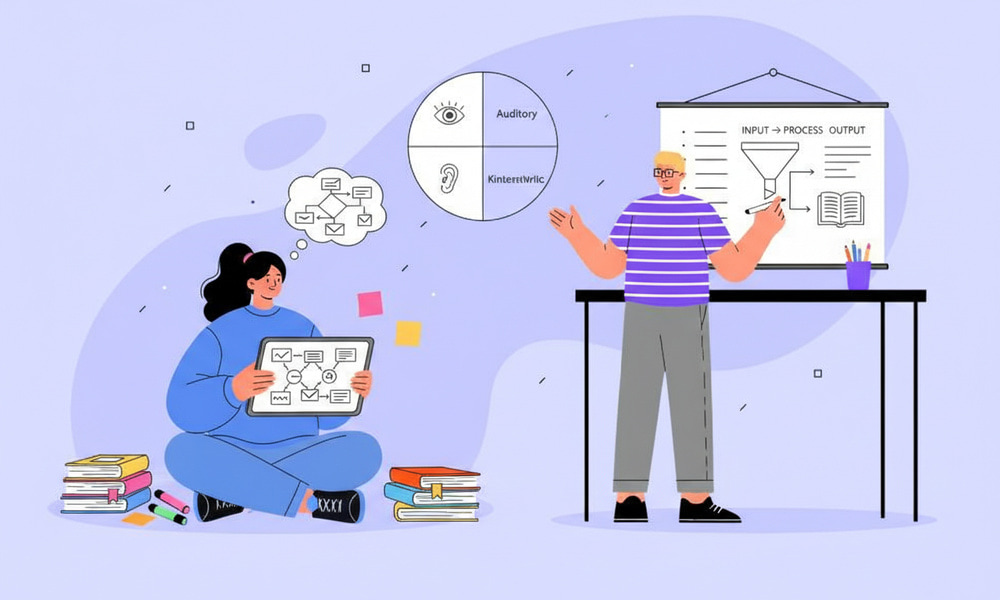
People absorb, process, and recall information in remarkably different ways, and those patterns often surface in the classroom, the lecture hall, and the workplace. Rather than relying on hunches about preferences, educators and professionals look for structured indicators that reveal how attention, memory, and motivation interact. The goal is not to pigeonhole anyone, but to illuminate tendencies that make practice, revision, and application more efficient and satisfying. In practice, a learning style assessment offers a guided snapshot of preferences across modalities such as visual, verbal, kinesthetic, and social dynamics, while emphasizing actionable strategies you can try immediately. Well-constructed questionnaires translate responses into patterns that you can test with real tasks, projects, and reflection, which keeps the process grounded in results rather than labels.
When institutions evaluate growth and performance, they also consider how preferences intersect with planning, feedback, and outcomes central to learner assessment, especially in programs where mastery unfolds across milestones. That context matters because preference profiles influence the selection of study tactics and materials, yet mastery still depends on deliberate practice and spaced review. Across schools and training programs, teams sometimes triangulate preference data with diagnostics similar to a learning styles assessment, using multiple measures to avoid bias and to create a richer learning picture. The most useful profiles highlight strengths, point to likely friction points, and suggest variations you can test, making it easier to design study playlists, rotate formats, and measure what actually boosts retention.
Popular Models, What They Measure, and When to Use Them
Several well-known frameworks map learning preferences, each with a distinct lens and vocabulary. Some focus on how we sense information, others on how we experiment and reflect, and still others on clusters of abilities that show up across everyday tasks. Used thoughtfully, these models supply ideas for experiments you can run the next time you read, take notes, or prepare for an exam.
| Framework | Primary Focus | Typical Use | Strengths | Cautions |
|---|---|---|---|---|
| VARK | Preferred input modes (Visual, Aural, Read/Write, Kinesthetic) | Quick self-checks to diversify study tactics | Easy to explain; practical strategy ideas | Do not treat modes as fixed or exclusive |
| Kolb Experiential | Cycle of experiencing, reflecting, conceptualizing, and experimenting | Course and curriculum design with active learning | Connects theory to practice and iteration | Needs reflection time to gain value |
| Multiple Intelligences | Broad ability domains (e.g., linguistic, spatial, interpersonal) | Project-based tasks and differentiated options | Encourages varied demonstrations of mastery | Not a replacement for skill-specific practice |
| Honey & Mumford | Action-oriented tendencies in learning activities | Workshop and training facilitation | Useful for team activities and debriefs | Avoid rigid categorization of people |
Many learners start with a concise screener like a VARK assessment, using the results to build a rotation of formats that make sense for the topic and task. If you want to emphasize experiential cycles of trying and refining, programs often reference a Kolb learning style assessment while planning labs, studios, or case-based seminars. Schools that value a broader talent map sometimes integrate a multiple intelligences assessment with project menus that let students demonstrate understanding in different ways. When instructors want modality ideas plus concrete habits, they may explore a VARK learning assessment and then anchor study plans in spaced practice and small retrieval challenges.
Benefits, Limitations, and Evidence-Informed Application
Used well, preference data can sharpen study design, improve engagement, and accelerate feedback cycles. The payoff comes from experimentation: trying an approach, measuring its impact on recall or skill execution, and keeping what sticks while discarding the rest. That evidence-first mindset prevents overgeneralization and keeps attention on outcomes rather than identity labels.
Programs that track progress often combine preference profiles with a broader learning assessment, aligning study tactics with the actual competencies being measured. Instructors can then recommend targeted strategies, such as dual coding for conceptual diagrams or low-stakes quizzing for vocabulary, to match the demands of the assessment while honoring personal tendencies. To maintain rigor, educators triangulate preference findings with performance data and rubrics from formal learning assessments, ensuring that personalization supports, rather than replaces, standards. With this balance, learners enjoy choice and variety without sacrificing the deliberate practice necessary for durable understanding, and teams can document the real effects of strategy shifts over time.
Tools, Platforms, and Practical Data Habits
Digital platforms make it easier to gather responses, visualize patterns, and translate insights into weekly routines. The best experiences move smoothly from questionnaire to concrete study experiments, showing learners exactly how to vary materials, environments, and time blocks to improve retention and transfer.
For program-wide rollouts, coordinators evaluate reliability, clarity, and privacy before adopting any learning style assessment tools, checking that reports are jargon-free and mapped to realistic tactics. Clear guidance helps participants try contrasting methods for reading, note-making, problem sets, and presentations, while simple dashboards show what’s working.
Remote and blended programs frequently deploy an online learning style assessment, pairing it with quick reflection prompts and micro-challenges that collect small bits of evidence. Over time, those check-ins reveal which combinations of medium, schedule, and social context produce the best results for different kinds of content, making personalization both actionable and measurable.
- Start with a short screener, then schedule a two-week experiment cycle.
- Use a scorecard to track recall, confidence, and time-on-task.
- Keep one variable constant while changing another to isolate effects.
- Review results and lock in two or three tactics that clearly help.
Designing for Adults and Students Across Contexts
Preferences shift with goals, prior knowledge, and work demands, so different audiences need different on-ramps. Workplace learners often juggle limited time and high accountability, while students balance foundation building with exploratory curiosity. Thoughtful design acknowledges those realities and tailors strategy menus to fit. Career coaches frequently weave findings from a learning style assessment for adults into onboarding plans, mapping practice to job tasks and emphasizing on-the-job retrieval. In that context, quick wins come from microlearning, spaced quizzes, and real artifacts used during practice, such as dashboards, forms, and client scenarios.

Campus programs adapt supports by integrating a learning styles assessment for students into study-skills courses, advising sessions, and peer tutoring. Advisors can then help learners adjust note-taking, concept mapping, and problem-solving routines to fit the rigor of specific courses without overfitting to one format. Equity-minded centers expand access by offering a curated, research-literate free learning style assessment, accompanied by worksheets that turn results into daily habits. That combination keeps the focus on action, reduces barriers to entry, and encourages experimentation across different subjects and time constraints.
Interpreting Results and Turning Insights Into Action
Profiles are most useful when they lead to concrete experiments that improve retention, transfer, and confidence. Treat any result as a hypothesis generator: try a tactic, collect evidence, and refine. Over time, you’ll build a personal playbook that mixes modalities, schedules, and collaboration in ways that fit both your goals and your constraints.
A reflective journal pairs well with a learning style self-assessment, because short notes about what worked, what didn’t, and what to tweak next week produce a running log of evidence. That log becomes the basis for rapid iteration: swap reading sequences, vary practice problems, or alternate between solo and group drills, then keep the combinations that demonstrably boost performance. To avoid pitfalls, resist rigid labels, keep attention on the task’s actual demands, and use preference data to diversify practice rather than narrow it. This approach ensures that you become more adaptable, not less, and that personalization serves the learning objectives rather than overshadowing them.
Take Learning Styles Assessment
Get StartedFrequently Asked Questions
-
Are learning preferences the same as abilities?
No. Preferences describe how you like to take in and work with information, while abilities reflect what you can currently do. The best approach is to use preference insights to try tactics that make tough material more approachable, then build ability through deliberate practice and feedback.
-
Can profiles change over time?
Yes. As your goals, context, and prior knowledge evolve, your preferred strategies can shift as well. That’s why short experiment cycles and reflective notes are essential, because they let you update your study playbook as tasks and constraints change.
-
How should teachers use results in class?
Use them to diversify options rather than track learners into fixed groups. Offer multiple ways to engage with concepts, encourage retrieval practice, and show students how to test strategies against real tasks, then keep what demonstrably helps mastery.
-
What evidence should I collect after a profile?
Track recall accuracy, error types, time-on-task, and confidence ratings after study sessions or quizzes. Simple scorecards and spaced checkpoints will reveal which tactics move the needle, helping you invest time where it pays off.
-
Do these tools replace universal design for learning?
No. Preference profiles can complement inclusive design by suggesting additional avenues for engagement and expression. Together, they help instructors offer flexible pathways while ensuring every learner can access core content and demonstrate understanding.